Showing posts with label LO 2a. Show all posts

Wednesday, March 2, 2011

Deutschland ist Hamlet

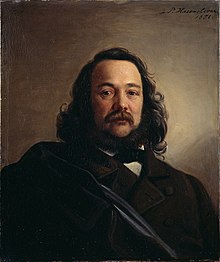
Here is the poem by Ferdinand Freiligrath from 1844 (source), that I mentioned before.  I have done my best in translating it into English for you, so that you can see what he is writing about.


Ferdinand Freilgrath
Hamlet
Ferdinand Freiligrath

Deutschland ist Hamlet! Ernst und stumm           Germany is Hamlet! Serious and Silent

In seinen Toren jede Nacht                                 Buried Freedom wanders about his gates 
Geht die begrabne Freiheit um                            Every night and waves at the men of the Watch.
Und winkt den Männern auf der Wacht.               There stands the High One, openly armed
Dasteht die Hohe, blank bewehrt,                        And says to the procrastinator, who still doubts,
Und sagt dem zaudrer, der noch zweifelt:            "Be for me a Revenger, Draw your sword!
"Sei mir ein Rächer, zieh dein Schwert!               They have trickled poison into my ear!"
Man hat mir Gift ins Ohr geträufelt!"

Saturday, February 26, 2011

Hamlet and Germany

In 1848 the German poet Ferdinand Freiligrath wrote a poem in which he wrote that "Germany is Hamlet", referring to the famous Shakespearean play, which toured Germany within five years of Shakespeare's death.  It seems that play never left.  
Ever since his famous poem, scholars have debated back and forth, looking for and finding or not finding themselves within the text.  Freiligrath's original poem describes Hamlet as being serious, and overly thoughtful, yet inactive.  He thinks too much and does too little, which Freiligrath saw in Germany of the 19th century, though he later wrote, "To the German Shakespeare Society of Weimar, Representative of a People  Whose Recent history has proved Once for all that "Germany is Not Hamlet."  (Look for a future post where I take a look more closely at that poem)

Monday, February 7, 2011

King Lear / König Lear

Once again I am reading this play in both English and German, but this time it's a little easier.  I have a copy of this play that has the original English text on the left side of the page and a German translation (from Raimund Borgmeier, Barbara Puschmann-Nalenz, Bernd Santesson, and Dieter Wessels).  This makes it easier to go back and forth and see just how the German text compares to the English.

The first thing I noticed is that the German translation abandoned the poetic structure of the English text, not even attempting to have a meter or a rhyme.  This is most evident in Lear's opening speech, which looks organized and separated by lines on the left hand of my book, but is a big, long paragraph of text on the right.

The other thing I noticed is the many footnotes in my German text.  Most of these, especially in the opening scene with Gloucester and Kent, explain the wordplay and puns which do not translate well, as anybody who has tried to tell a joke in a foreign language knows.   One of my favorite German jokes makes absolutely no sense in English.
Zwei Jäger treffen sich im Wald.  Beide sind tot.
The joke here is in the double meaning of 'sich treffen' which can mean either to meet or to hit (as in with ammunition). Thus the joke is that two hunters meet or hit each other in the forest.  Both are dead.  As I said, it doesn't work well in English, but there you go.

Saturday, February 5, 2011

Taming of the Shrew and Shakespeare's Comedies

In class we discussed the traditional elements of Shakespearean comedies.  As we talked about these I tried to associate each one with Taming of the Shrew.  I found that most of them fit, but I had a hard time finding a few of these elements in the play.  Let's go through each one, shall we?

Standard elements of Shakespearean comedies:

Friday, February 4, 2011

New thoughts to Taming of the Shrew and Gender Roles

I just finished reading the play, and though I rather enjoyed it, laughing at the wordplays and the puns, I find myself rethinking what I thought about how Katherina is treated by Petruchio.


Until this latest reading of the play, my strongest connection to it was acting in a production in high school.  The actress that we had playing Kate played her very well, in my opinion, but mostly it seemed like she was humoring Petruchio the entire time.  Especially in Act 4 Scene 5, when they are travelling and Petruchio calls the sun the moon and gets Kate to agree that it is the moon, only to ridicule her for her mistake. In our production of this scene, the actress playing Kate said the lines as they appear in the script:
"Then, God be bless'd, it is the blessed sun; But sun it is not, when you say it is not; And the moon changes even as your mind. What you will have it nam'd, even that it is, And so it shall be so for Katherine."
But as she said these lines there was overt sarcasm in her voice.  And later, as she apologizes to Vincentio for calling him a woman, she glared at Petruchio, blaming him silently for making her look foolish.


That is how I have always read this play, as Kate simply playing along with Petruchio and his madness, because she got tired of fighting him and suffering the consequences.  Which I guess means that Petruchio did indeed tame her. But even as she recited the last speech, there was still a little hint of defiance.  And maybe it helped that our Petruchio (one of the nicest, kindest guys I have ever met) did not play the part as mean or as angry as he could have, from the text alone. I have never seen this play as oppressive to women, but this latest reading I was struck by just how blatant the spousal abuse really is.


I have tried to justify Petruchio's behaviour in light of his line, "This is a way to kill a wife with kindness",

Tuesday, February 1, 2011

Taming of the Shrew Act 1 / Erste Akt

I have read the first act of the play, including the induction.  I really like the induction, and I'm sad that it's cut out of most productions as unnecessary.  Partly this is because, when my high school did this I played the part of Christopher Sly, but mostly because I think it sheds light on one of the main themes of the play:  Identity and how  people act when they are treated a certain way.  
Sly is a drunkard found asleep in the streets, and a passing Lord decides to have some fun and dress him up and pretend that he's noble.  The servants take him and dress him and serve him as if he were a Lord, until Christopher Sly believes he is a lord.  The line is "Would not the beggar then forget himself?", "Würde der Bettler nicht sein selbst vergessen?" and the servant says, "he shall think by our true diligence he is no less than what we say he is."  "er soll es glauben daß er nichts anders ist, als wir ihn nennen".


I see the same theme played out in the play, with Katherina.  She is a shrew and as others keep calling her a shrew she continues to be a shrew. But when Petruchio treats her like a lady, like a respectable wife, she begins to believe that she can be that.  For me, the play is not about "taming" a woman, making her subservient. but allowing her to be something more than others allow her to be.  It's the medieval version of Johnny Lingo -- he calls her an 8-cow wife so she begins to believe that she is worth 8 cows.  More on this as I continue to read the play and find lines that speak to this point.
Kate and Petruchio in the Polynesian islands?

Saturday, January 29, 2011

An Apology for Richard

I have been reading and writing about Richard II lately, but today in class I sat in on a small group discussion about Richard III, a play and a character that I am very familiar with.
First, there is no relation between the two Richards, who ruled England nearly 80 years apart.  Just the briefest of history lessons: Richard II was deposed by Henry IV, whose grandson Henry VI was deposed by Edward IV, who died leaving the throne empty for his brother Richard III.  


As I mentioned, I have study Richard III quite a bit,  two years ago I wrote a 6 page paper in defense of Richard, and last year I wrote a 16 page paper defending him and comparing him to a character in a German novel who I saw as very similar.  Let me set up my defense of Richard, but with one caveat: I do not condone Richard for what he did.  He is a villain, a devil, an evil, evil man who committed many atrocities.  But, I can begin to understand him and where he came from.


The question is asked again and again, "Why is Richard the way he is?"  And for me, part of the answer has to be, That is the way society made him.


Thursday, January 27, 2011

Was Shakespeare revolting?

 Please excuse the poor pun in the title, but I want to write about something I came across while studying Richard II: Shakespeare's subversive nature.  Especially with the play Richard II, many see Shakespeare's plays as swaying public opinion either for or against the monarch.  In Richard II, an upstart young noble, Henry Bolingbroke manages to overthrow the king, which is not generally the kind of thing kings enjoy.  Elizabeth I is reported as once having said, "I am Richard II, know ye not that?", there were those who thought her unfit as a monarch, partly because she had never married, never produced an heir.  The Earl of Essex, reportedly, on the night before his planned rebellion against Elizabeth, paid the Chamberlain's Men to perform Richard II.  He was imprisoned and later executed, but the thought remains -- does Richard II have anything to do with revolution?  Does this play speak either for or against deposing a monarch?

The Earl of Essex turns his back on Queen Elizabeth I, , from COMIC ENGLISH HISTORIES by Dick Doyle, 1886.

Monday, January 17, 2011

Ophelia's madness

I will admit, there is one thing that has always bothered me about most productions of Hamlet:  Ophelia.  I have never really understood her character, her purpose.  We first see her as her brother and then her father tell her that she cannot love Hamlet.  Then we see her as she tells her father of Hamlet's antic behaviour.  Then there is the strange scene between Hamlet and Ophelia after the "to be, or not to be" speech, which concludes with Hamlet telling her, essentially, to buzz off.  But despite this, Hamlet makes some pretty suggestive comments as he flirts with her while watching the play-within-the-play.  We next see Ophelia after Hamlet has killed her father, and she is completely mad, child-like and nonsensical.

It wasn't until I watched Slings and Arrows, the Canadian television show based around a Shakespearean festival where they perform Hamlet, that I began to get a deeper insight into her character.  In the show there is a terrible actress who has been cast as Ophelia, who also does not fully understand her character, which leads to the following scene where the director, who has had a history with madness, tries to explain things.  I love the way he describes her.

Wednesday, January 12, 2011

Hamlet, Acts 2 and 3

These two acts have some more impressive speeches, including my absolute favorite - "What a piece of work is a man."   What I found very interesting with this reading is the word "a".  I have always thought the speech was "What a piece of work is man" when it really says "What a piece of work is a man." That single word "a" makes a huge difference.  Without it Hamlet seems to be speaking about mankind in general, all of us at once, collectively.  But he is really speaking about a man, an individual.  Each of us individually are "noble in reason", "infinite in faculties", "In action how like an angel", "in apprehension how like a god."  Each of us have within ourselves this immense power of potentiality.  Not just as a whole.  Sometimes I am a little cynical and find it hard to see the "Götterfunken" - spark of God, as Schiller writes it - in individuals, when it is easier to see this power collectively.  


Of course, at this point Hamlet is very much in his melancholy moment, despairing, having "lost all [his] mirth."  He speaks these wonderful words about the grandeur of humanity, only to follow them with, "to me what is this quintessence of dust? Man delights not me -no, nor woman either." He is fed up with the world and the injustices he sees in it. 


And then of course there is Act 3, scene 1, "To be, or not to be."  Such a famous speech, everybody and their dog knows it, it must be hard for an actor to step into the role of Hamlet knowing that he will have to perform this speech.  As Jack says in Slings and Arrows: